Technical Document Review Workflow: Stages, Stakeholders & Approvals
02 Jun

Table of Contents
ToggleA technical document review workflow is the governed sequence of stages a technical document moves through before publication: peer review, SME review, editorial review, compliance review, and final approval, with defined reviewers, deliverables, and sign-off criteria at every stage.
A well-designed workflow gives documentation leads three things: complete review coverage (no SME feedback missed), full traceability (every comment, version, and approval recorded), and audit-ready governance (defensible proof of who signed off, when, and on what). This guide breaks down the seven stages, the stakeholders accountable at each, the artifacts that prove sign-off, and the tools that operationalize the workflow without forcing reviewers into your authoring system.
Blog Summary
- A technical document review workflow is the governed sequence of stages a document moves through before publication: drafting, peer review, SME review, editorial review, compliance review, final approval, and post-release tracking.
- Documentation review is a release-risk and audit-exposure problem, not a productivity one. Slipped launches, audit findings, and missed compliance signoffs all trace back to the same broken workflow.
- The three principles of a workflow that holds up under audit: stage-gated reviews with explicit exit criteria, reviews conducted on rendered output rather than source files, and every approval captured as a timestamped, identity-bound artifact.
- SME review (stage three) is where most documentation review workflows actually break. Fragmented feedback across Slack, email, PDF, and Word is the single biggest cause of missed comments and version ambiguity.
- “Audit-ready” means six specific things: traceability, accountability, auditability, governance, review coverage, and versioning. Each maps to a regulated-industry standard (FDA 21 CFR Part 11, ISO 9001, SOC 2, GDPR).
- Authoring tools (MadCap, Paligo), document management systems (Confluence, SharePoint), generalist proofing tools (Filestage), and engineering-native review (GitHub PR) each own part of the workflow. None owns all of it.
- zipBoard is the review operations layer that sits alongside the authoring system, brings every reviewer onto rendered output through a shareable link, and captures every comment, version, and approval as an audit-ready artifact. The native AI review layer runs first-pass checks across stages one, two, three, and five.
- Teams that move from email-and-Slack reviews to a governed review workflow typically see review cycle times drop by 40 to 60% and audit retrieval time drop from days to seconds.
Why Is a Technical Document Review Workflow a Release-Risk Problem?
For most documentation leads, the review cycle is what nobody sees until it is late. Engineering ships on schedule, marketing has the launch deck ready, and then the docs slip, because SME review came back fragmented across three channels, two comments got missed, and compliance was looped in five days too late.
In regulated environments like medical devices, pharma, fintech, and aerospace, a slipped launch date is the smaller problem. The bigger one is audit exposure. When a regulator asks who approved this version of this document, and when, the answer cannot be a forwarded email thread or a Slack message from six months ago. A defensible review trail is a material business control. Treating it as paperwork is what generates the audit finding.
For the tooling side of this workflow, see how zipBoard handles technical document review and SME sign-off.
Here is what that looks like in the documentation lead’s day:
- SMEs comment in Slack, email, marked-up PDFs, and Word tracked changes in parallel, with no single source of truth
- Reviewers work on stale versions because nobody knows which draft is current
- Comments get addressed verbally and never resolved in writing
- Approvals are captured as “looks good” replies that disappear into inboxes
- Cross-functional reviewers are locked out of the authoring system and default to whatever channel is easiest
- Launch dates slip because the documentation lead is reconstructing the review history instead of running it
Documentation teams that move from email-and-Slack reviews to a governed workflow typically see review cycle times drop by 40 to 60%. A better authoring tool will not produce that result. A governed review workflow will.
What Is a Technical Document Review Workflow?
A technical document review workflow is the structured, multi-stage process that a technical document moves through between drafting and publication. Authoring tools like MadCap, Paligo, Confluence, and Docusaurus produce the content. The review workflow governs how that content gets validated, signed off, and released as an approved, audit-ready document.
Three principles separate a workflow that holds up under audit from one that quietly leaks:
1. Sequence the review with stage gates. Reviews happen in a defined sequence with explicit exit criteria at each stage. A document does not move from SME review to compliance review until every SME comment is resolved, deferred with a rationale, or escalated. Parallel free-form review, where everyone comments at once in whatever channel they prefer, is what produces missed feedback and version ambiguity.
2. Review on the rendered output. SMEs, legal, compliance, and product reviewers should review what the end user will see, whether that is the HTML help topic, the PDF, the SCORM module, or the published article. Forcing non-writers into MadCap or oXygen guarantees one of two outcomes: they do not review, or they review badly.
3. Treat every approval as an artifact. Sign-off creates a timestamped, identity-bound, version-referenced record stored alongside the document it approves. A “looks good” reply in an email thread does not qualify. If it did not happen in the workflow, it did not happen.
The 7 stages of the document review lifecycle
Every technical document moves through the same seven stages between first draft and published asset. What separates a team that ships on time from one that slips comes down to three operational details at every stage: a defined owner, a clear exit criterion, and a record that survives the handoff.
Stage 1 — Drafting and self-review
The technical writer produces the first complete draft against an internal checklist covering structure, style guide application, terminology consistency, accessibility, and internal cross-references. Known content gaps get marked as “TBD-SME” with a named owner, never left blank. AI pre-checks run here: style compliance, terminology, readability, accessibility, catching mechanical issues before any reviewer sees the document.
Exit criteria: draft passes the self-review checklist, all gaps marked TBD-SME with a named owner, all internal references resolved, AI pre-checks clean.
Common failure mode: writers skip self-review under deadline pressure and push raw drafts into peer review. Peer reviewers then spend their time on issues the checklist would have caught, burning a cycle that should have been spent on structural feedback.
Stage 2 — Peer review
A peer technical writer or editor reviews the draft for structure, clarity, voice, and adherence to the documentation standard — checking whether the document reads as it belongs in the broader doc set: same voice, same terminology, same level of detail.
Exit criteria: every peer review comment either resolved or explicitly deferred with a rationale and a target stage for follow-up.
Common failure mode: small teams skip peer review because “there’s only one writer who knows this product.” Three releases later, the doc set reads like four different people wrote it, because it did, and voice drift is now expensive to fix.
Stage 3 — SME review
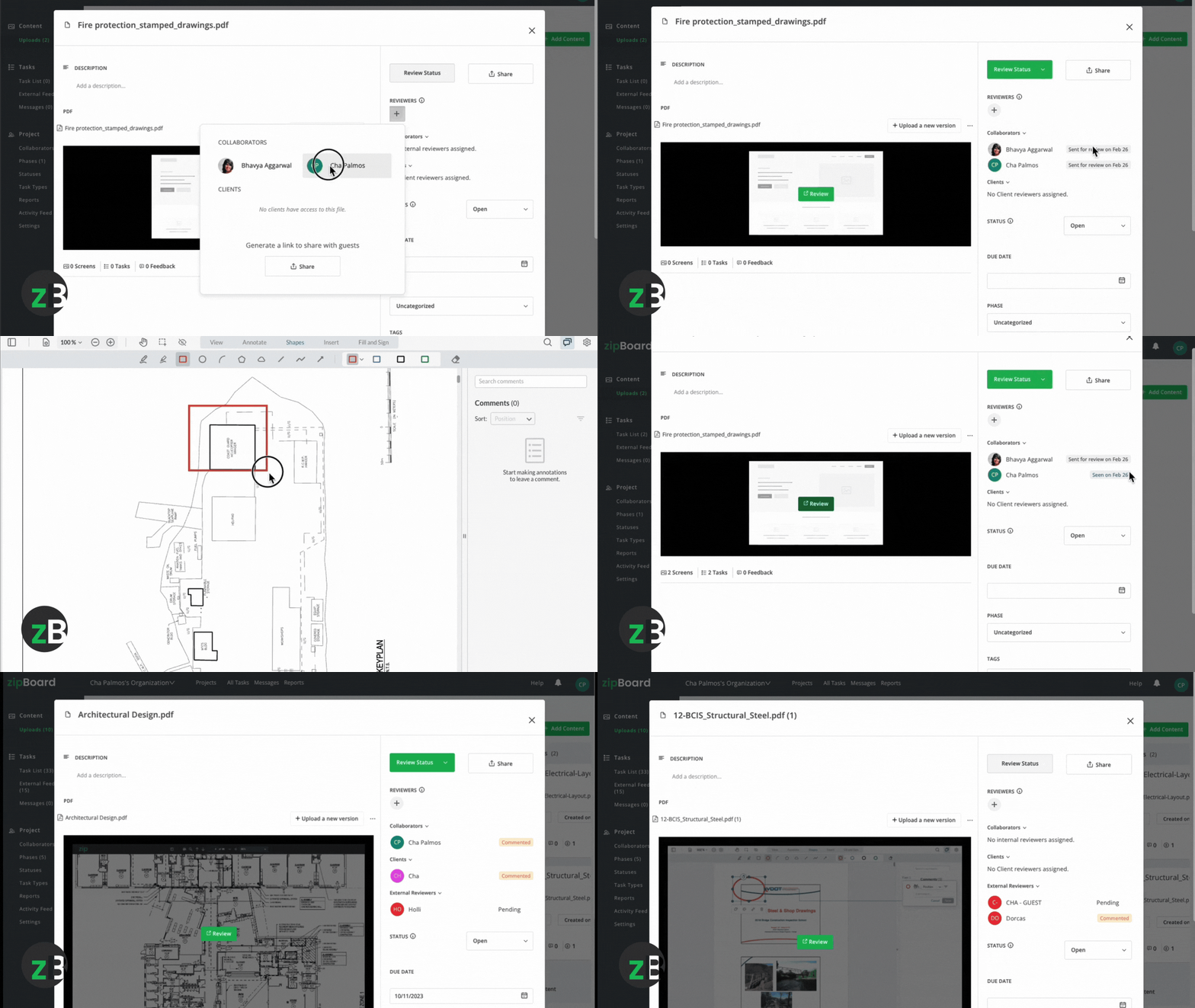
Subject-matter experts validate technical accuracy on the rendered output. Engineers check API examples. Product managers check that described workflows match what shipped. Support leads check that troubleshooting steps reflect actual tickets. The SME pool is typically one to four people per document; for cross-functional features, it can reach eight or more.
Categorize SME comments on intake: technical-accuracy issues (must fix), clarity issues (writer’s judgment), scope expansion (defer to next cycle), personal-preference (acknowledge, often close without action). This lets the documentation lead triage signal rather than read every comment chronologically.
Exit criteria: every SME comment categorized, then resolved, deferred with rationale, or escalated. No open comments at stage close. Every reviewer’s input accounted for, with explicit evidence of who reviewed which sections.
Common failure mode: this is where most documentation review workflows actually break. SMEs comment across Slack, email, Word, and PDF simultaneously. Comments get missed; version ambiguity sets in when one reviewer had Tuesday’s draft, and another had Thursday’s. By reconciliation time, there is no clean record of who reviewed what.
Stage 4 — Editorial review
The editor runs the copy-edit pass: grammar, consistency, readability, terminology compliance, and sentence-level clarity. New terms introduced during SME review get evaluated against the glossary, approved or rejected, and propagated to the style guide for the next cycle.
Exit criteria: copy-edit complete, terminology database updated, style guide deviations fixed or documented as intentional exceptions.
Common failure mode: editorial review is cut under deadline pressure. Three releases later, the doc set has four different terms for the same UI element and a style guide that no longer matches what is published.
Stage 5 — Compliance and legal review (where applicable)
Documents touching clinical claims, financial disclosures, security commitments, accessibility statements, or contractual language must route through compliance, legal, regulatory affairs, or QA before final approval. Loop compliance in at Stage 3, when the document is still flexible enough to absorb structural changes. Catching a prohibited claim two days before launch forces rework that a Stage 3 flag would have avoided.
Exit criteria: compliance sign-off recorded as a timestamped artifact tied to the specific document version reviewed.
Common failure mode: compliance is involved too late because nobody identified the document as touching regulated content until the editor flagged it. Late-stage compliance feedback blows the launch timeline.
Stage 6 — Final approval
The documentation lead or product owner gives the final sign-off, captured as a timestamped record bound to the approver’s identity and tied to the specific version. The version locks at approval. Any subsequent change triggers a new approval cycle scoped to the changed sections only.
For cross-functional launches, final approval often requires multiple approvers: documentation lead (editorial quality), product owner (accuracy to the shipped product), engineering manager (technical correctness), and launch lead (release-readiness). Each approval is captured as a separate artifact.
Exit criteria: approval captured as an artifact, timestamp, approver identity, version reference, for every required approver.
Common failure mode: approvals captured as forwarded email threads or “+1” replies. Six months later, when an auditor asks who approved this version, the documentation lead cannot produce a clean answer.
Stage 7 — Publication and post-release tracking
The document ships with the product GA. The approved version, with its complete review history, gets archived as the system of record for that release. Post-release, the workflow shifts to feedback intake: support tickets, user-reported issues, sales and customer success feedback, and doc page analytics all loop back into the next review cycle’s planning.
Exit criteria: the published version is archived alongside its complete review history, accessible to documentation, compliance, and audit functions without requiring re-creation.
Common failure mode: the approved version is published but never archived with its review history. When an audit happens 18 months later, the documentation lead can produce the current version but cannot reconstruct who approved the version that was live at the time of the incident.
Who's accountable at each stage: the RACI for the SME review process and approvals
A review workflow without explicit accountability defaults to whoever feels most guilty about the missed launch date. A RACI matrix makes accountability legible at every stage. R = Responsible, A = Accountable (one per stage), C = Consulted, I = Informed.
RACI: Technical document review workflow
| Stage | Technical Writer | Peer Reviewer / Editor | SME | Documentation Lead | Compliance / Legal | Product Owner |
|---|---|---|---|---|---|---|
| 1. Drafting and self-review | R, A | I | I | I | — | I |
| 2. Peer review | R | R, A | I | I | — | I |
| 3. SME review | R | I | R | A | C | C |
| 4. Editorial review | C | R, A | I | I | — | I |
| 5. Compliance and legal review | C | I | C | C | R, A | C |
| 6. Final approval | C | C | C | A | C | R |
| 7. Publication and post-release tracking | R | I | I | A | I | I |
Who owns SME review coordination? The technical writer is responsible for running it — assigning sections, chasing comments, reconciling feedback, closing the stage. The documentation lead is accountable for the outcome. If SME review takes nine days instead of four, the conversation goes to the lead, not the writer. Splitting responsibility from accountability prevents writers from owning workflow problems they do not have the authority to fix.
Where does compliance fit? Compliance is consulted starting at Stage 3 and accountable at Stage 5. Documentation leads who only loop compliance in at Stage 5 reliably get late-stage rework. Treat compliance as a Stage 3 participant and a Stage 5 owner.
Who has final approval authority? In product-led companies, the product owner holds final approval and the documentation lead is accountable for the document being review-complete. In compliance-heavy environments, approval routes through a quality manager or regulatory affairs lead. In docs-as-code teams, it is captured as a merge-to-main with named approvers in the pull request. Who holds the pen varies. The artifact requirement does not.
Approvals, audit trails, and versioning: What audit-ready means in a documentation approval workflow
“Audit-ready” gets used loosely in documentation tooling marketing. Operationally, it means six specific things.
Traceability. Every comment is tied to a named reviewer, a specific document version, a timestamp, and a resolution status. Nothing exists in a side channel.
Accountability. Every stage has a named owner and a defined exit criterion. Missed deadlines surface on day two, not day ten.
Auditability. When an auditor asks who approved this version and when, the answer is one click, not three to five days of inbox archaeology.
Governance. The workflow is the system of record. Side-channel approvals over Slack or email get rejected as input, not absorbed retroactively. This sounds rigid until the first time it saves the team during an audit.
Review coverage. The documentation lead can see, at any moment, what percentage of the document each required reviewer has covered and which sections remain outstanding.
Versioning. Every reviewed version is archived alongside its complete comment history and approval record. The reviewed-and-approved version from eighteen months ago is retrievable with the same one-click access as last week’s draft, full review history intact.
What regulated industries actually require:
- FDA 21 CFR Part 11: electronic records and electronic signatures, with audit trails for every change
- ISO 9001: document control with defined review and approval workflows
- SOC 2: change management evidence, including documented review and approval for system documentation
- GDPR: record-keeping requirements for any documentation that touches personal data handling
A workflow that meets these standards has an audit trail, role-based access, and electronic signatures built in. Bolted-on equivalents fail the audit when the auditor asks for evidence of integrity controls.
Why Do Most Documentation Review Workflows Break?
Documentation review workflows do not break in mysterious ways. They break in the same five ways, across every company, every industry, and every authoring stack.
Fragmented review channels and reviewers outside the authoring system. Reviewers default to the fastest tool available: Slack, email, PDF, Word tracked changes, while cross-functional reviewers will not enter MadCap or Paligo just to leave a comment. The documentation lead ends up reconciling feedback across five channels per cycle. The fix: a single review surface on rendered output, delivered through a shareable link requiring no account or license. Teams that centralize the review surface typically see SME review turnaround drop by 50% within sixty days.
Version ambiguity. Multiple drafts are in flight simultaneously and reviewers comment on stale versions without knowing a newer draft exists. The fix: bind every review session to a specific document version. When a new version drops, the system opens a new session and archives old comments against the version they applied to.
Unresolved comments. Without enforced exit criteria, comments accumulate as “we’ll get to it” and surface post-release as defects or audit findings. The fix: stage gates that require every comment resolved, deferred with rationale, or escalated before the document advances.
No proof of approval. Verbal approvals and “looks good” email replies cannot satisfy an auditor six months later. The fix: Every approval becomes a timestamped, identity-bound artifact stored alongside the specific version it approves.
Manual review effort that does not scale. As documentation volume grows, human reviewers spend more time on mechanical checks, terminology consistency, accessibility, broken cross-references, regulatory checklists, that do not require judgment. The fix: an AI review layer that runs first-pass checks before any human reviewer opens the document, so reviewers spend time only on decisions that require human attention.
Document review software for running a technical document review workflow
No single tool runs the entire workflow well. Most documentation teams end up with a stack: an authoring system, a storage layer, a review surface, and an AI layer for mechanical checks.
Tool comparison: Technical document review workflow
| Stage | Technical Writer | Peer Reviewer / Editor | SME | Documentation Lead | Compliance / Legal | Product Owner |
|---|---|---|---|---|---|---|
| 1. Drafting and self-review | R, A | I | I | I | — | I |
| 2. Peer review | R | R, A | I | I | — | I |
| 3. SME review | R | I | R | A | C | C |
| 4. Editorial review | C | R, A | I | I | — | I |
| 5. Compliance and legal review | C | I | C | C | R, A | C |
| 6. Final approval | C | C | C | A | C | R |
| 7. Publication and post-release tracking | R | I | I | A | I | I |
The table reads cleanly once the categories are clear. Five patterns explain how the tools cluster.
Authoring tools (MadCap, Paligo, FrameMaker, oXygen) own stages 1, 2, and 4. Their built-in review modules work for writer-on-writer review and break the moment a cross-functional reviewer is involved.
Document management systems (Confluence, SharePoint) handle storage and basic approval routing but fail at contextual visual review on rendered output. Per-reviewer licensing is a barrier for external participants.
Generalist proofing tools (Filestage, Ziflow, Frame.io) are built for creative assets and lack the audit trail depth regulated documentation requires.
Engineering-native review (GitHub PR, GitLab MR) works for docs-as-code teams but excludes any reviewer who will not learn Git.
Review operations platforms (zipBoard) sit alongside the authoring system and own stages 3, 5, 6, and 7. Every reviewer, SME, legal, compliance, external partner, works on the rendered output through a shareable link with no account or license required. Every comment, version, approval, and audit trail is captured in one governed workflow, with an AI review layer running across stages 1, 2, 3, and 5.
See zipBoard run review operations end-to-end:
- Book a workflow demo → See how documentation teams use zipBoard for full-cycle review operations
- See SME review without accounts → Cross-functional reviewers comment on rendered output through a shareable link
- See unresolved comments tracking → Stage gates that surface stalled reviews on day two, not day ten
- See the audit trail in action → Every comment, version, and approval as a timestamped, identity-bound artifact
Templates for the documentation approval workflow and review cycle
Technical Document Review Checklist. Self-review (stage 1) and editorial review (stage 4) in one file. Covers structure, style, terminology, accessibility, cross-references, and content gaps. Available in Excel, Word, and PDF.
Review Coverage Matrix. Live tracker for stage 3 SME review. Maps every section against every required reviewer with completion status and outstanding comment counts. [Download the Review Coverage Matrix — coming soon]
SME Review Tracker. Reviewer-by-reviewer view of stage 3: who’s assigned, who’s responded, what is outstanding. For documentation leads managing five or more SMEs. [Download the SME Review Tracker — coming soon]
Documentation Approval Workflow Template. The end-to-end documentation approval workflow template covers all seven stages, with named owners, exit criteria, and approval artifacts at each stage. Adaptable for product-led, compliance-led, and docs-as-code teams. [Download the Documentation Approval Workflow Template — coming soon]
RACI for Documentation Reviews. The full RACI matrix from the accountability section above, as an editable spreadsheet. [Download the RACI for Documentation Reviews — coming soon]
Document Release Readiness Checklist. Final approval checklist for stage 6: every required sign-off confirmed, every comment resolved or deferred with rationale, every approval artifact captured. [Download the Document Release Readiness Checklist — coming soon]
FAQs - Technical Document Review Workflows
Peer review (stage 2) is conducted by another technical writer or editor and focuses on structure, voice, clarity, and documentation standards. SME review (stage 3) is conducted by subject-matter experts and focuses on technical accuracy. Both are required for a governed workflow, but they answer different questions.
The documentation lead is accountable for the document being review-complete and ready for approval. The named approver varies — product owner, quality manager, or regulatory affairs lead. What does not vary: every approval must be a timestamped, identity-bound artifact tied to the specific version approved.
A governed cycle for a typical product release document takes three to seven business days: one day for self-review, one to two for peer review, two to three for SME review, one for editorial, and one to two for compliance and final approval. Email-and-Slack-driven cycles for the same document typically run ten to twenty business days. The difference is the wait time between stages, not reviewer effort.
Accountability for missed deadlines stays with the documentation lead regardless of which reviewer missed the window. Build stage-level visibility so a stalled review surfaces on day two, not day ten. The lead’s job is to escalate early, not to chase reviewers after the launch date has already slipped.
A governed review cycle for a typical product release document takes three to seven business days end-to-end: one day for self-review, one to two days for peer review, two to three days for SME review, one day for editorial review, and one to two days for compliance and final approval. Email-and-Slack-driven cycles for the same document typically take ten to twenty business days. The difference is the wait time between stages. Reviewer effort stays the same in both cycles.
Accountability for missed reviewer deadlines stays with the documentation lead, regardless of which reviewer missed the window. The fix is workflow design: build stage-level visibility so a stalled review surfaces on day two, not day ten. The lead’s job is to make missed reviews visible early enough to escalate, not to chase reviewers individually after the launch date has already slipped.
Review is the activity of evaluating a document against criteria such as accuracy, clarity, compliance, and completeness. Approval is the gate that authorizes publication. Approval without prior review is what creates audit findings.
An AI review layer handles first-pass mechanical checks across stages: style guide compliance at stage 1, structural and terminology checks at stage 2, comment clustering at stage 3, regulatory checklist verification at stage 5, and audit summary generation at stage 7. AI cannot replace SME review. Technical accuracy requires domain expertise and shipped-product reality that no model replicates. AI handles the work that does not need judgment so humans can focus on the work that does.
GitHub PR or GitLab MR for the engineering-side review, paired with a review operations platform that opens the rendered output, published HTML, PDF, or built docs site, for SME, legal, compliance, and external review through a shareable link. The engineering team stays in their native environment. Everyone else reviews the artifact they actually consume.
Turning the Workflow into an Operational System
The workflow in this guide is the framework. The checklists, coverage matrices, RACI templates, and approval records are what make it operational. The tools are what make it scalable across releases, teams, and regulated environments without the documentation lead becoming the bottleneck on every launch.
Documentation leads who run this well treat reviews as a governed business process, not a productivity tax. That shift is what earns documentation a seat at the launch table and keeps it off the slipped-dates report. Review operations is to documentation what DevOps is to engineering: the layer that makes everything else faster, safer, and audit-ready.
If you’re ready to see what review operations look like running end-to-end, zipBoard’s content operations platform is built around exactly the workflow on this page. Walk through a live SME review cycle, an audit-trail export, and an approval artifact with a member of the team. If you want to start with the artifact rather than the tooling conversation, the Technical Document Review Checklist is free in Excel, Word, and PDF, the same checklist that drives stage one self-review and stage four editorial review in the workflow above.


Recent Posts
- How to Review AI-Generated eLearning Courses (and Get Them Approved Faster) October 22, 2026
- 7 Best Fieldwire Alternatives for Construction Teams September 29, 2026
- How to Track Content Approvals Across Multiple Projects (Without Missing One) September 25, 2026
- How to Compare Two PDF Versions Without Losing Track of Changes September 1, 2026
- Why IT Teams Are Getting Out of the PDF Review Server Business August 20, 2026
Features
Compare
©️ Copyright 2026 zipBoard Tech. All rights reserved.